This is an interdisciplinary "Civilization Operation System" designed to elevate Spatial Intelligence from a technical means of improving comfort to a fundamental methodology for guaranteeing the continuity of extraterrestrial civilization. This white paper systematically expounds on the 7-Layer Theoretical Architecture of EE-SSS and its core technical pathways, providing a blueprint for building sustainable, resilient, and meaningful interstellar homelands.
A Methodological Framework for Extraterrestrial
Civilization Construction
Publisher: Qianjia Smartech | SSSU Design
Bureau Chief Architect:
Zhonghong Xiang Release Date:
January 27, 2026 Version: V
1.0 (Genesis Release)
Executive Summary
Human
aerospace exploration is at a historic critical point, transitioning from the
"Age of Exploration" to the "Age of Settlement." However,
current engineering practices are critically unbalanced: we have solved the
problem of "How to Arrive" (heavy-lift launch vehicles), but have not
yet solved "How to Survive and Thrive" (smart habitats). Earth-based
architecture and smart home experiences fail completely in the face of Martian
radiation, microgravity, and extreme resource scarcity.To
address this, Mr. Zhonghong Xiang, founder of Qianjia Smartech, officially
proposes "Extreme-Environment
Smart Space Science" (EE-SSS). This is an interdisciplinary
"Civilization Operation System" designed to elevate Spatial Intelligence from a
technical means of improving comfort to a fundamental methodology for guaranteeing the continuity of
extraterrestrial civilization. This white paper systematically expounds on
the 7-Layer Theoretical
Architecture of EE-SSS and its core technical pathways, providing a
blueprint for building sustainable, resilient, and meaningful interstellar
homelands.
Chapter 1: Paradigm Shift
1.1 The Failure of Earth
Experience On
Earth, architecture acts as a static container defending against nature, and
resources are viewed as infinite supplies. However, in extreme extraterrestrial
environments, Space equals Life.
Any lack of systemic redundancy, open-loop metabolism, or psychological
oversight will lead to mission failure.
1.2 Definition of EE-SSSExtreme-Environment Smart Space Science (EE-SSS) is a
discipline that studies how to create smart survival spaces with biological-level resilience and
civilizational evolutionary
capabilities in extreme physical environments (extraterrestrial bodies,
deep sea, polar regions) through standardized construction, dynamic matter generation,
collective intelligence, and human-factors optimization.
Chapter 2: The 7-Layer Theoretical
Architecture
The
EE-SSS system is structured like precision-interlocked concentric circles,
expanding from the physical cornerstone at the center to the frontiers of
civilization.L1.
Foundation Layer: Universal Framework
·Five
Hubs & Six Elements Theory (FHSET): Defines the neural system of space
(Sensing, Connection, Interaction, Computing, Executing) and its metabolic
targets (Light, Air, Sound, EM Waves, Energy, Visuals).
·Smart
Space Standard Unit (SSSU):
Defines the 2m×2m×2.4m standardized "Civilization Cell." It is the lowest common denominator
for physical construction and digital computing, enabling the discretization
and replication of interstellar construction.
L2.
Core Layer: Construction & Interaction
·Honeycomb-Cupola
Symbiosis Theory (HCS):
Establishes the macro-structural paradigm of "Underground Hexagonal
Honeycombs (Survival) + Surface Transparent Cupolas (Living)."
·Theory
of Dynamic Object Generation (TDOG): Revolutionizes static material reserves
by utilizing programmable matter and in-situ manufacturing to achieve
"print-on-demand" and "recycle-on-completion" of spatial
facilities.
·Embodied
Spatial Existence and Interaction of Digital Humans (ESEIDH): Endows AI companions with
"Spatial Entities" and "Physical Agency," transforming them
from screen-bound images into true co-living roommates and collaborative nodes.
L3.
Resilience Layer: Survival Assurance
·Spatial
Immunity and Self-adaptive Repair Theory (SIRT): Endows space with a biological immune
system. It utilizes distributed sensor networks (Nerves) to identify micro-meteoroid
impacts or radiation damage, dispatching self-healing materials and
micro-robots (White Blood Cells) for active repair.
·Spatial
Metabolism & In-situ Resource Cycling Theory (MRCT): Views the base as a closed
super-organism, establishing an atomic-level accounting system for
matter-energy flows to achieve nearly 100% closed-loop conversion from waste to
resources.
·Embodied
Spatial Cognition and Psychosphere Theory (ESC): Uses the "Six Spatial Elements"
as neuro-modulators. Through active recipes of dynamic spectra, soundscapes,
and digital fenestration, it heals astronaut psychological crises in confined
environments, constructing a "Psychosphere."
·Trans-Planetary
Ergonomics (TPE):
Redefines furniture dimensions, movement trajectories, and interface damping
specifically for the low-gravity environments of Mars (0.38g) and the Moon
(0.16g), creating a new lifestyle adapted to "Neutral Body Posture."
L5.
System Layer: Intelligent Evolution
·Spatial
Collective Emergence of Intelligent Agents (SCE): Abandons fragile central control for a
decentralized "Parallel
Collaboration" architecture. Everything is an agent, emerging global
survival intelligence through local interactions.
·Spatial
World Model & Generative Reality Theory (SWM-GR): Introduces an AI World Model
as the base's "Prefrontal Cortex." Utilizing SSSU structured data, it
simulates future disasters and response strategies in latent space, guiding the
generative reconstruction of physical space to achieve a leap from
"Automation" to "Prophetic Intelligence."
L6.
Civilization Layer: Meaning & Ethics
·Spatial
Narrative and Meaning Generation Theory (SNG): Combats technological alienation and
historical nihilism. Using holographic inscription and dynamic ritual engines,
collective memories are written into physical walls, transforming cold survival
containers into "Places" carrying cultural identity.
·Spatial
Social Topology and Ethical Boundaries Theory (SST-E): Establishes "Biological
Human Priority" and the "Right of Last Physical Refusal."
Through code-based constitutions and physical privacy shutters, it builds an
ethical firewall against algorithmic tyranny.
L7.
Evolution Layer: Dual-Planet Symbiosis
·Planetary
Civilization Calculus & Morphology (PCCM): Ultimately, EE-SSS points towards the Dual-Planet Symbiosis of
Earth and Mars. Martian technology feeds back to Earth (e.g., extreme
recycling), while Earth's culture nourishes Mars, jointly driving humanity to
ascend to a Kardashev Type I civilization.
Chapter 3: The Ascension Blueprint
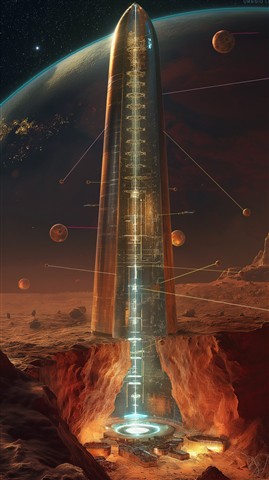
Visual Title: The
Ascension Blueprint of Martian Civilization The image presents a cross-section of a
growing, rocket-shaped underground honeycomb city:
·[Base] Glowing SSSU/FHSET cubes rooted in
red soil;
·[Skeleton] Upward-growing HCS honeycombs and TDOG printing arms;
·[Shield] Outer SIRT immune halos and MRCT circulation pipes;
·[Core] Central SCE/SWM-GR pulsating
optical brain;
·[Life] Distributed cozy ESC/TPE habitats and ESEIDH digital avatars;
·[Spire] The cupola breaking through
the surface, containing SNG
monuments, connected by the SST-E ethical grid, pointing towards the stars.
Conclusion: The Source Code of
Civilization
The
release of the EE-SSS theoretical framework marks the historic metamorphosis of
Spatial Intelligence. We are no longer just designing houses; we are writing a
set of "Civilization Source
Code" capable of running on the surface of any planet.This
code is both hard, building fortresses of survival with basalt and algorithms;
and soft, nurturing the human soul with light, shadow, and narrative. As
Earth's starships tear through the sky, EE-SSS will serve as the most solid "Soft Infrastructure,"
escorting the spark of human civilization to take root, sprout, and prosper in
the red soil.
Appendix: About Us
【About Mars Habitat Channel】A frontier exploration
platform under Qianjia Smartech, and the digital twin validation ground for the
EE-SSS theory. Dedicated to connecting Earth's intelligent industries with
extraterrestrial construction needs, it previews the future of human multi-planetary
survival through a "Three-Step Strategy": Earth Analog, Moon Outpost,
and Mars City.
【About Qianjia Smartech】 China's leading smart space
service platform and the industrial foundation of the SSSU Design Bureau. Since
its establishment in 2000, it has been committed to driving the evolution of
architecture from "Machines for Living" to "Intelligent
Lifeforms," advocating for the era of "Spatial Awakening."
【About Zhonghong Xiang】 The Founding Father of Spatial
Intelligence and Chief Architect of the EE-SSS theory. With the unique
perspective of a "Practical Thinker," he has constructed a complete
theoretical closed loop from Earth-based smart homes to extraterrestrial
civilization operating systems, calling for the industry to shift from "Earth
Involution" to "Interstellar Dimensional Reduction."






参与评论 (0)